What Are Volatile Organic Compounds? (VOCs)
Understanding Chemical Off-Gassing, Health Impacts, and Layered HVAC Air Purification Strategies

Volatile Organic Compounds (VOCs) are among the most common—and least understood—indoor air contaminants. Released from everyday personal and cleaning products, furnishings, and building materials, these invisible gases affect occupant health, comfort, cognitive performance, and overall building performance.
As organizations increasingly recognize that indoor air quality is an asset, understanding how to identify, monitor, and reduce VOCs has become an essential component of creating healthier, higher-performing facilities.
What Are Volatile Organic Compounds (VOCs)?
Volatile Organic Compounds are a large family of carbon-based chemicals that readily evaporate into the air at room temperature. Because they easily become airborne gases, VOCs accumulate rapidly indoors—particularly in modern energy-efficient buildings designed with tight envelopes and reduced natural ventilation.
While some VOCs occur naturally, most indoor VOCs originate from manufactured products, synthetic furnishings, and construction materials. Many of these compounds continue to re-gas over time through off-gassing, turning VOC exposure into an ongoing indoor air quality challenge rather than an isolated event.
Common Indoor VOC Chemical Compounds:
- Formaldehyde: Released from composite wood adhesives, building materials, and resin products.
- Benzene and Toluene: Found in paints, finishes, solvents, and fuel emissions.
- Xylene and Acetone: Present in adhesives, aerosol sprays, and commercial cleaning agents.
- Limonene: Used as a synthetic fragrance in scented cleaners, air fresheners, and personal hygiene products.
- Ethylene Glycol, Perchloroethylene, and Methylene Chloride: Derived from dry cleaning solvents, strippers, and industrial degreasers.
Common Sources of Indoor VOCs
Unlike outdoor air pollution, indoor VOCs primarily originate from the very products used to build, furnish, and maintain commercial spaces.
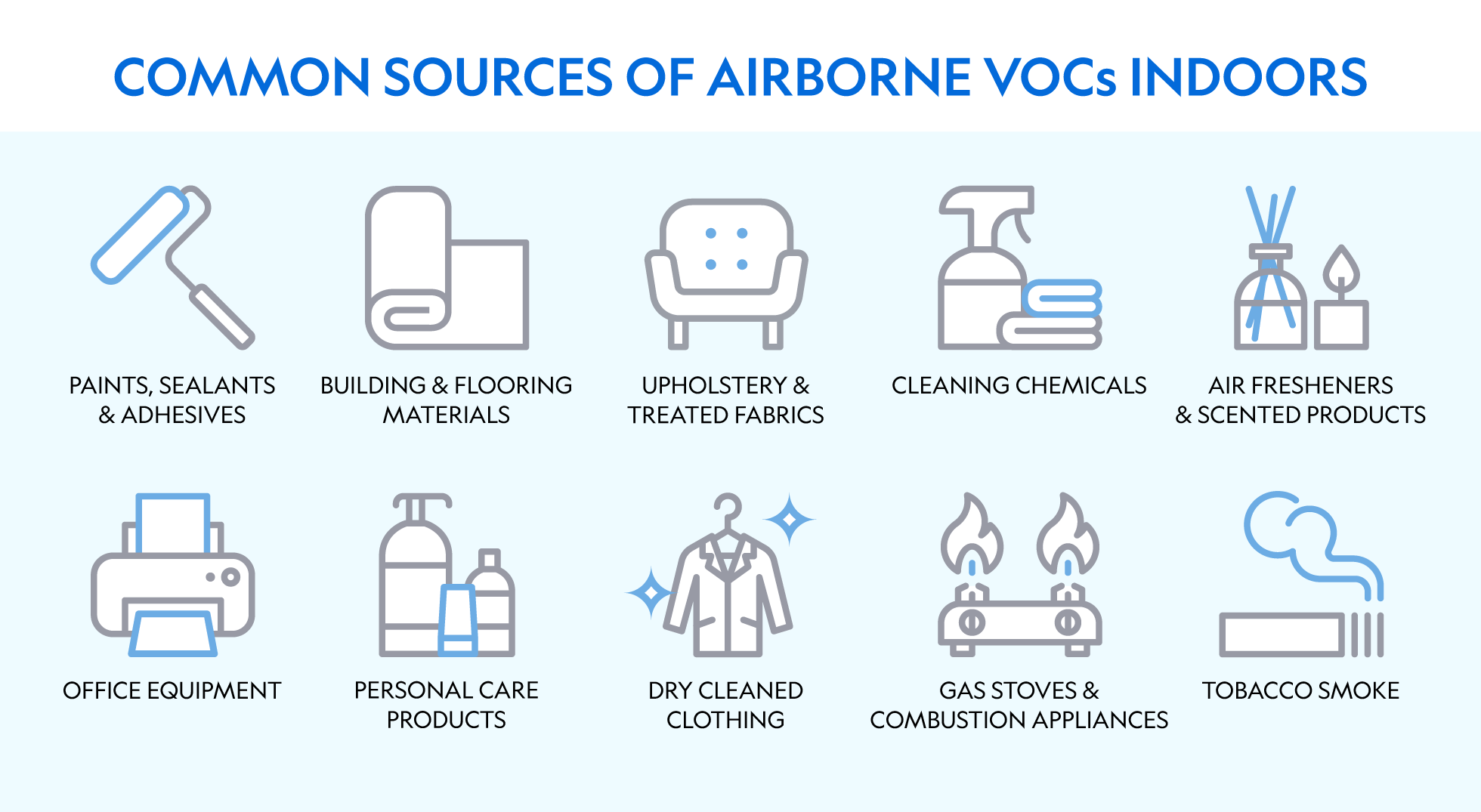
Primary Indoor Emission Sources Include:
- Paints, lacquers, sealants, and construction adhesives
- Flooring, wall coverings, and composite wood furniture
- Upholstery and flame-retardant treated fabrics
- Commercial cleaning, disinfecting, and degreasing chemicals
- Air fresheners, deodorizers, and scented consumer goods
- Office equipment including high-volume copiers and laser printers
- Personal care items, lotions, and perfumes
- Gas stoves, boilers, and combustion appliances
- Environmental tobacco and thirdhand smoke residue
Because people spend approximately 90% of their time indoors, these everyday chemical emissions require deliberate management within any comprehensive facility IAQ strategy.
Health Impacts of VOC Exposure
While many people associate VOC exposure with mild chemical odors, the physiological effects range from acute mucous membrane irritation to chronic systemic disease.
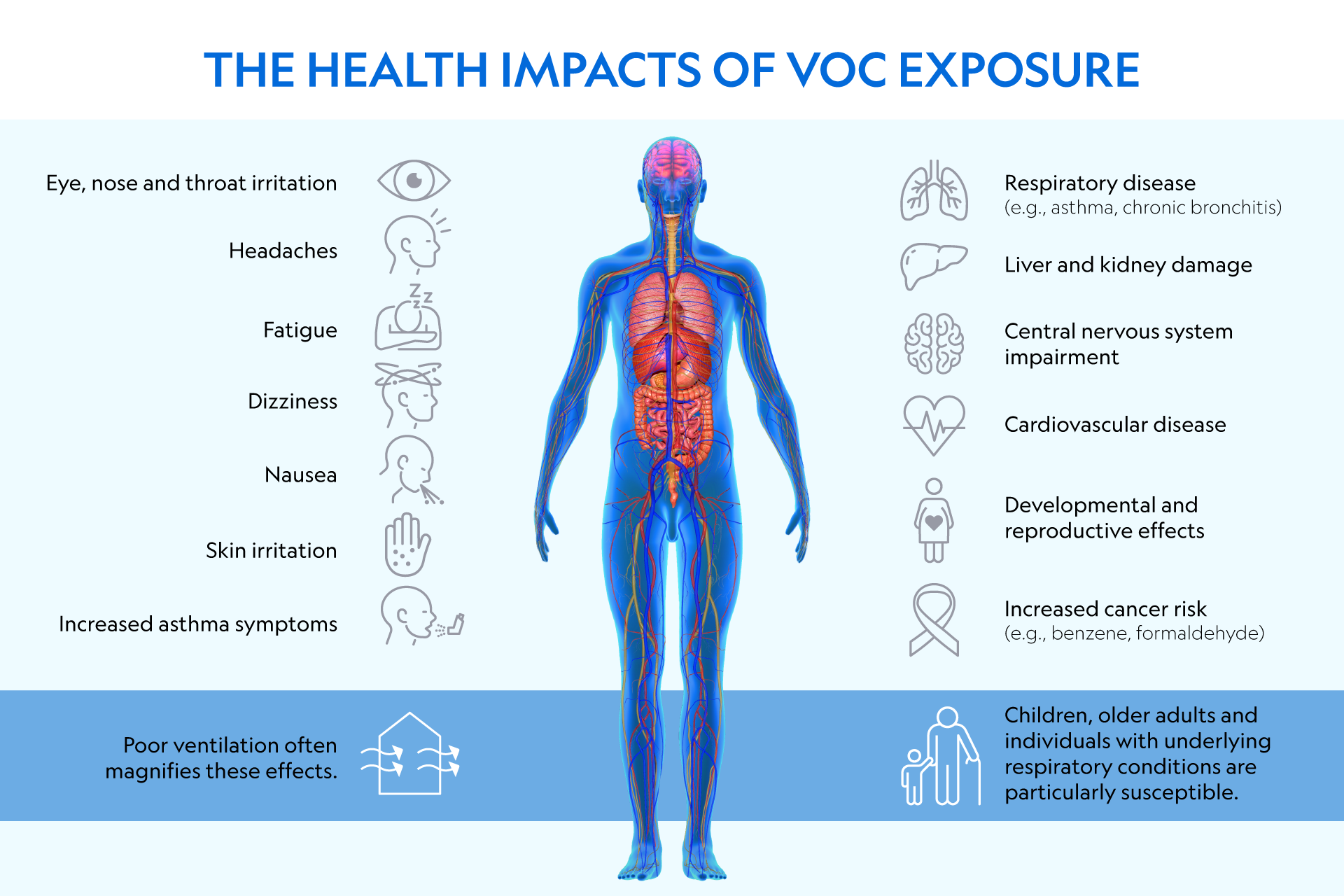
1. Short-Term Exposure Effects
Elevated short-term VOC concentrations in poorly ventilated spaces contribute directly to:
- Eye, nose, and throat irritation
- Frequent headaches and dizziness
- Fatigue and impaired cognitive focus
- Nausea and skin irritation
- Exacerbation of asthma attacks and allergic reactions
2. Long-Term Exposure Effects
Prolonged, chronic exposure to gaseous pollutants is clinically linked to:
- Chronic respiratory illness and reduced lung capacity
- Hepatic (liver) and renal (kidney) damage
- Central nervous system impairment
- Cardiovascular disease and inflammation
- Elevated cancer risk from known human carcinogens like benzene and formaldehyde
How VOCs Impact Building Performance and Asset Value
Indoor air quality is no longer evaluated purely as a facilities task. Research confirms that maintaining healthy indoor environments improves occupant satisfaction, reduces workplace absenteeism, and enhances cognitive function.
For organizations pursuing healthy building certifications—such as WELL, LEED, and RESET Air—managing Volatile Organic Compound thresholds is essential for achieving compliance and protecting property value.
Why Traditional Ventilation and Mechanical Filters Fall Short
While outdoor air ventilation is foundational under ASHRAE Standard 62.1, ventilation alone cannot completely resolve VOC challenges. Outdoor intake air can contain traffic emissions or wildfire smoke, and over-ventilating increases energy costs during peak heating and cooling seasons.
HVAC Filters Do Not Capture Gases: Standard particulate filters (including high-efficiency MERV 13 to MERV 16 filters) trap dust, pollen, and bioaerosols, but gaseous VOC molecules pass directly through mechanical media. Controlling airborne chemicals requires gas-phase technology.
A Layered Strategy for Indoor VOC Reduction
Mitigating gaseous chemical pollutants effectively requires a multi-layered IAQ framework:
- Source Control: Selecting low-emitting GREENGUARD-certified building materials, low-VOC paints, adhesives, and non-toxic cleaning agents to prevent off-gassing at the source.
- ASHRAE-Compliant Ventilation: Maintaining adequate outdoor air exchange to dilute baseline indoor chemical concentrations under ASHRAE Standard 62.1.
- Gas-Phase Activated Carbon Media: Utilizing activated carbon filtration containing millions of microscopic pores that adsorb chemical gas molecules from circulating duct air.
- Soft Ionization Air Purification: Integrating Soft Bipolar Ionization to promote oxidation reactions that reduce volatile organic compounds while agglomerating fine particulate matter for easier capture.
- Continuous Air Quality Sensing: Deploying real-time IAQ monitors to track Total Volatile Organic Compounds (TVOCs), particulate matter, carbon dioxide, temperature, and humidity continuously.
Smarter Buildings Require Better IAQ Visibility
The evolution of smart building management relies on actionable data. Real-time TVOC tracking enables facility teams to identify chemical spikes immediately following renovation or cleaning, validate HVAC performance, and transition from reactive maintenance to data-driven operational management.
Conclusion: Protecting Occupants and Property Performance
Volatile organic compounds represent a significant but manageable indoor air hazard. By implementing a layered approach combining source control, gas-phase carbon filtration, soft ionization, and continuous monitoring, building operators can protect occupant health and optimize long-term asset performance.
Discover how WellAir clean air technologies support healthier indoor environments.
Sources & Related IAQ Reading
- U.S. Environmental Protection Agency (EPA). Technical Overview of Volatile Organic Compounds (VOCs) in Indoor Air. EPA Air Quality. Read overview.
- WellAir IAQ Series. The Air We Breathe: Particulate Matter (PM2.5) Risk Analysis. WellAir Solutions. Read guide.
- WellAir IAQ Series. The Air We Breathe: Bioaerosols Explained. WellAir Solutions. Read guide.
- WellAir IAQ Series. Allergens and Pollen: How Indoor Air Quality Helps You Breathe Easier. WellAir Solutions. Read guide.