Particulate Matter: A Risk to Health & Building Performance
The Invisible Air Quality Risk Facing Facilities

The Invisible Risk You Can’t Ignore
Air pollution is often viewed as an outdoor issue visible in haze, smoke, or urban smog. However, one of the most dangerous pollutants is invisible and far more pervasive indoors.
Fine particulate matter (PM2.5) is an airborne contaminant that infiltrates buildings, accumulates indoors, and directly impacts human health, cognitive performance, and operational outcomes.
Global health organizations recognize air pollution as one of the largest environmental threats to human health, contributing to 6.7 million premature deaths annually [1]. Newer estimates suggest that number may reach 8.1 million deaths each year [2], placing air pollution on par with smoking and poor diet [3].
Critically, long-term exposure to PM2.5 accounts for more than 4.1 million deaths worldwide [4]. Fine particulate matter bypasses natural respiratory defenses, enters the bloodstream, and persists in indoor environments where people spend up to 90% of their time.
What Is Particulate Matter (PM)?
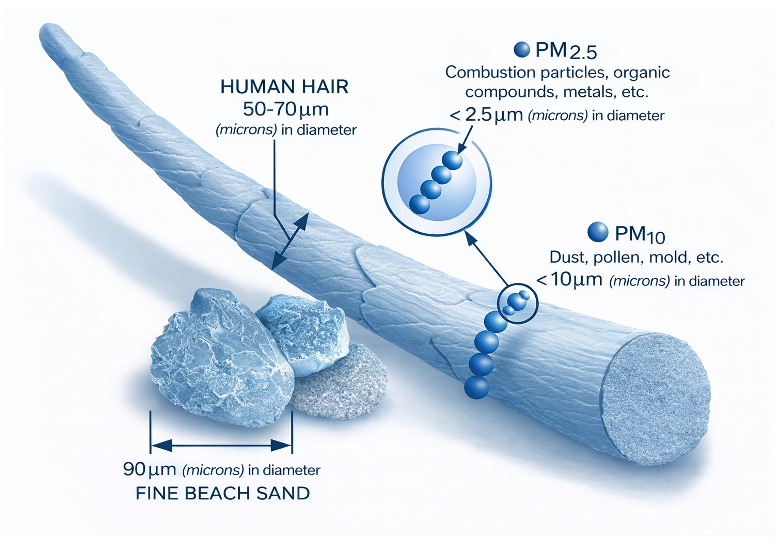
Particulate matter refers to a complex mixture of microscopic solid particles and liquid droplets suspended in the air. These particles range from visible dust to ultrafine particles invisible to the human eye.
Particulate Matter Classification by Size:
- PM10 (Coarse Particles): Diameter ≤10 microns (e.g., dust, pollen, mold).
- PM2.5 (Fine Particles): Diameter ≤2.5 microns (e.g., combustion particles, organic compounds).
- PM1 and Smaller (Ultrafine Particles): Diameter ≤1 micron, capable of penetrating tissue directly into the bloodstream.
PM2.5 particles are approximately 30 times smaller than a human hair, allowing them to bypass nasal passages and travel deep into the lungs.
Why Particulate Size Matters for Human Health
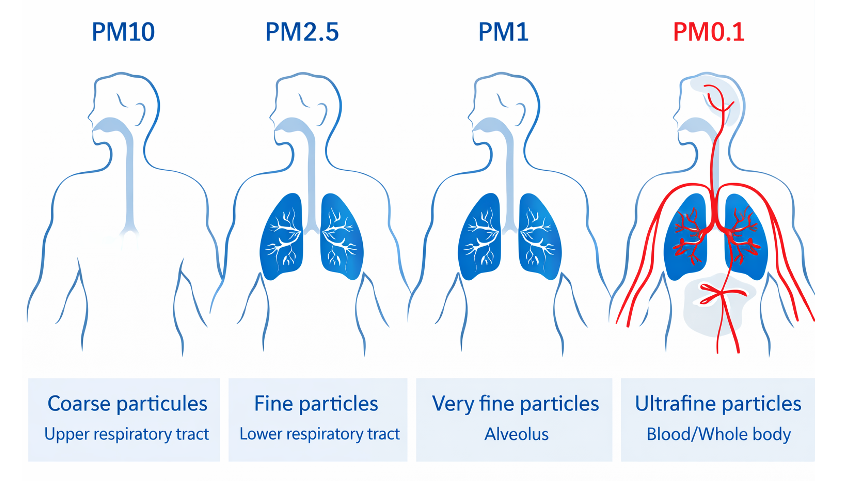
The smaller the particle, the deeper it penetrates the body. Fine and ultrafine particles:
- Reach the deepest alveolar regions of the lungs.
- Cross the blood-air barrier directly into the bloodstream.
- Circulate continuously throughout biological systems.
Where Does PM2.5 Come From?
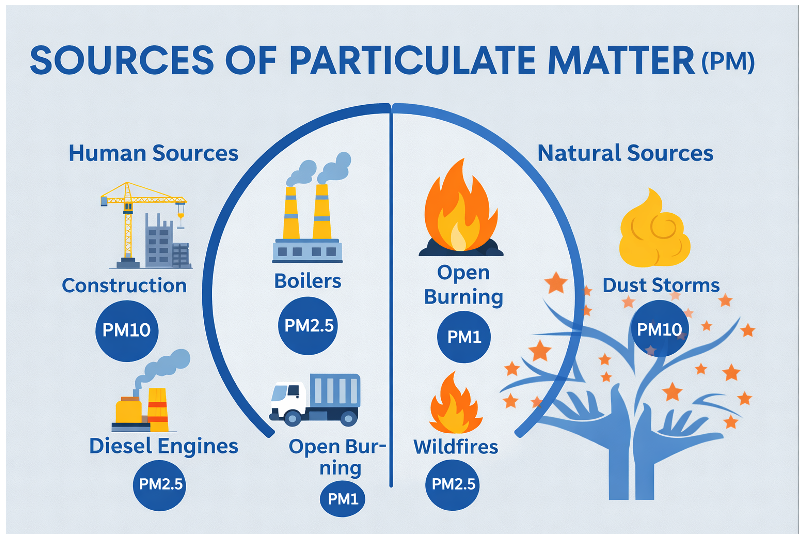
Particulate matter originates from both outdoor infiltration and internal indoor activities:
- Combustion Sources: Vehicle emissions, wildfire smoke, industrial exhaust.
- Indoor Sources: Cooking emissions, cleaning sprays, office printers, resuspension of floor dust.
- Biological Particles: Pollen fragments, mold spores, bacteria, pet dander.
- Environmental Sources: Construction dust, soil minerals, wearing of building materials.
Health Risks of PM2.5 Exposure
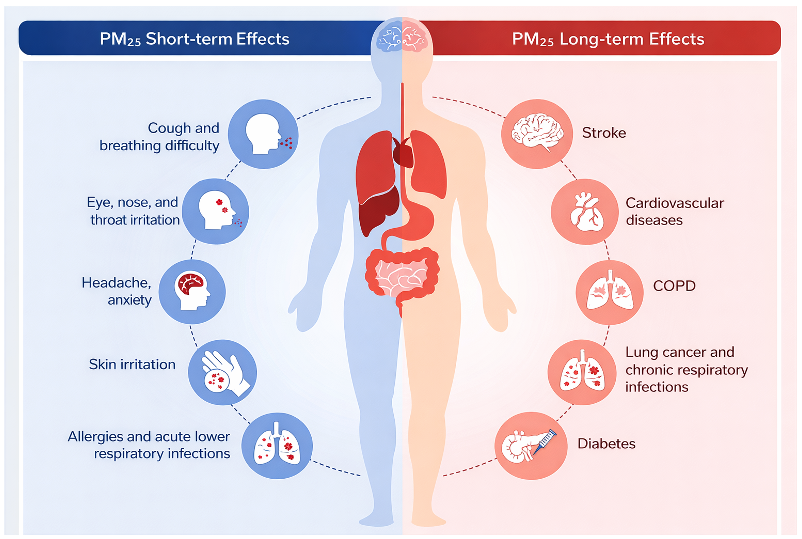
Cardiovascular and Respiratory Disease
PM2.5 is recognized as the leading environmental risk factor for premature death globally [5]. In fact, 68% of air pollution-related deaths stem from cardiovascular conditions, including heart disease and stroke [6].
Systemic Physiological Impact
Exposure to fine particles extends far beyond the lungs:
- Triggers systemic inflammation and oxidative stress [7].
- Increases incidence of chronic respiratory diseases such as COPD and lung cancer [7].
- Correlates with higher all-cause mortality rates across age demographics [8].
- Causes over 120,000 premature deaths annually among older adults in the U.S. [9].
Conversely, lowering PM2.5 yields immediate health benefits: reducing ambient concentrations by 10 µg/m³ can increase average life expectancy by up to 0.35 years [11]. Research shows health risks occur even at low exposure levels below current regulatory limits [8].
Cognitive Impact & Operational Risk (OpEx)
Elevated PM2.5 levels directly impair brain function and workplace productivity. Studies link high fine-particle concentrations to reduced concentration, slower decision-making, higher error rates, and poor sleep quality.
Because indoor air directly impacts human and building performance, PM2.5 represents a major operational expense (OpEx) risk:
- Commercial Offices: Reduced cognitive performance, increased sick leave, lower productivity.
- Educational Facilities: Impaired student learning metrics and lower test scores.
- Healthcare Settings: Heightened infection risks for vulnerable clinical patients.
- Manufacturing & Cleanrooms: Equipment degradation, product contamination, operational downtime.
4 Ways to Reduce PM2.5 in Buildings
Mitigating fine particulate matter requires a system-based approach combining mechanical filtration, soft ionization, and continuous indoor air monitoring:
- High-Efficiency Filtration: Upgrading to higher MERV or HEPA filters traps physical particles. Novaerus Portable Disinfection Units combine a triple-filter system with NanoStrike™ technology for localized particulate management.
- Soft Bipolar Ionization: Soft ionization releases active positive and negative ions into the air. These ions cause fine particles to agglomerate (cluster together), increasing their physical mass so HVAC filters capture them more easily without increasing fan energy. Plasma Air HVAC Solutions deliver whole-building ionization.
- Multi-Technology Purification Systems: Combining mechanical filtration with active purification provides broad protection across all particle sizes.
- Real-Time IAQ Monitoring & Validation: Installing air sensors allows facility managers to track particle spikes, make data-driven ventilation adjustments, and validate IAQ performance. WellAir NanoDetect + NanoView systems turn air quality into a measurable asset.
Transforming an Invisible Threat into a Performance Asset
Particulate matter, particularly PM2.5, is one of the most significant risks in indoor environments today. With the right combination of air sensing, active purification, and filtration, particulate matter can be measured, managed, and controlled.
At WellAir, we believe clean indoor air is a performance-driven asset for every facility.