BacNet IP Connection
Published

NanoDetect PRO BacNet IP Connectivity
Download the BACnet IP Communication Guide
The NanoDetect PRO sensor supports BACnet IP communication over an Ethernet interface. Configuration is performed using the mobile application.
Step 1 Open the mobile application and select “Settings” (bottom right of the screen).
Step 2 Select “Direct Configuration.”
Step 3 Select the sensor type “NanoDetect PRO.”
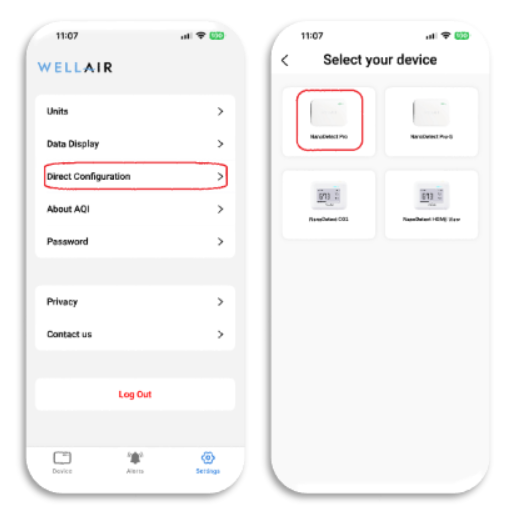
Follow the on-screen instructions to place the device into configuration mode. This can be done either by power cycling the sensor (disconnect and reconnect power) or by pressing the sensor button twice.
Step 4 Select “Next Step” to continue.
A list of available devices will be displayed. Devices are identified by MAC address and device name.
Step 5 Select the appropriate NanoDetect PRO from the list.
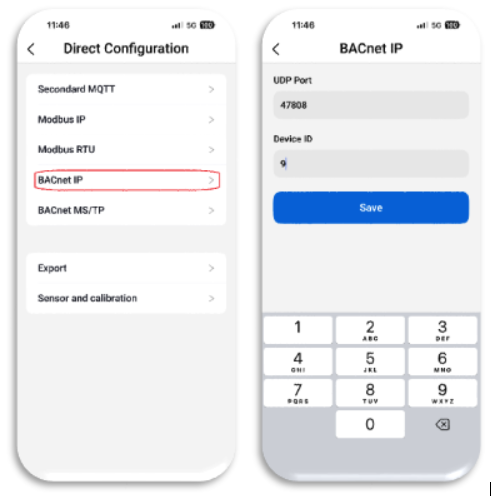
Step 6 From the communication options, select “BACnet IP.”
Step 7 Enter the required BACnet IP parameters:
• UDP Port
• Device ID
Step 8 Select “Save” to apply the settings. A long audible beep confirms successful configuration.
Communication Parameters
BACnet IP uses standard Ethernet and UDP transport. Serial communication parameters such as baud rate, parity, and stop bits do not apply.
Default BACnet IP UDP port: 47808.
If a different UDP port is configured, the BACnet client (PLC, SCADA, BMS, etc.) must use the same port number.
The Device ID must be unique across the entire BACnet internetwork. No other BACnet device (including routers or controllers) may use the same Device ID.
Ethernet Connection
The NanoDetect PRO provides a 10/100Base-T Ethernet interface with an RJ45 connector located on the rear of the device. Connect the device to the local area network using a standard Ethernet cable.
Network Configuration
The device must be assigned valid IP network parameters to communicate on the network. The device operates using DHCP (automatic IP address assignment). Ensure that a DHCP server is available on the network.
Protocol Notes
The BACnet object structure and data points used for BACnet IP communication are identical to those defined for BACnet MS/TP. All object identifiers, scaling factors, and data formats remain the same.
BACnet Protocol
BACnet Interoperability Building Blocks Supported:
DS-RPM-B DS-COVP-B
Segmentation Capability:
Not supported
Standard Object Types Supported:
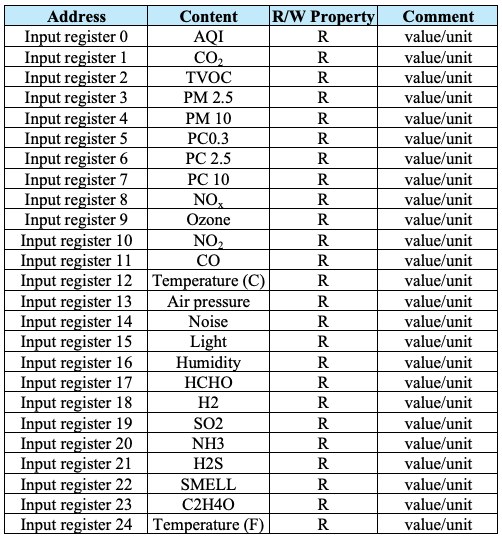
Device Address Binding:
Not supported
Networking Options:
None
Character Set Supported:
ISO 10646 (UTF-8)
BACK TO SUPPORT CENTER